
Does Afro Hair Grow? The Hair Growth Cycle, Explained
Have you ever heard, or quietly believed, that Afro hair just doesn't grow? It's one of the most common narratives in our community. And it's simply not true.
Unless a medical professional has told you otherwise, your hair is growing from your scalp every single day. The challenge for most of us isn't growth. It's keeping the length we grow. Understanding how the hair growth cycle works changed how patient I was with my own Afro, so let's break it down.
The three phases of the hair growth cycle
All hair, whatever the texture, moves through three phases (unless a medical professional has said otherwise).
1. Anagen: the growth phase
This is the longest phase, typically lasting two to seven years depending on your genetics, age and health. The follicle is actively producing new cells, and hair grows on average about half an inch (roughly 1.27cm) a month. This is the golden period for length retention, so give your follicles the best possible conditions. As we age, growth slows and anagen gets shorter.
2. Catagen: the transition phase
This lasts a few weeks. The follicle shrinks and detaches from its blood supply, and growth slows or stops. You can't influence this phase, but understanding it helps manage your expectations.
3. Telogen: the resting phase
This lasts about three months. The follicle is inactive and the old strand is eventually pushed out by a new one. That's shedding, and it's natural. Excessive shedding, though, could point to scalp issues, practices that aren't serving you, or health issues that need looking at.

How much shedding is normal?
We lose around 50 to 100 strands a day, sometimes more. So if your hair has gone seven days unwashed, you could have around 700 strands to wash out on wash day. That's natural. Hair coming out in clumps, though, may be a cause for concern and should be assessed by a dermatologist straight away.
Chronic stress, illness, dieting and pregnancy can push follicles into a premature resting phase, often leading to more shedding six to twelve weeks after the trigger. Look after your general health, your mental wellbeing and your stress levels.
Your hair is a material
Only the follicle under your scalp is alive. Once the strand emerges, it's non-living, and like any material it weakens as we touch, wash and style it. That's normal. Our job is to slow that degradation down. It's also why diet, hydration and nutrition matter so much: the only real way to affect the health of hair as it grows is through what goes into your body first.
“When we obsess over length, we ignore the importance of health.”
— Paige Lewin, How to Love Your Afro
What is a length limit?
Everyone has a genetic length limit, and most of us never reach it. It's how long your hair is at the end of its growth phase, having retained as much length as possible along the way.
Shrinkage isn't hair loss
Shrinkage is the difference between your hair's stretched length and its length in its natural coily state. The strands haven't got shorter; the bends and coils make them bunch up. Generally, shrinkage is a sign of healthy hair.
How to retain more length
- Detangle gently. Only when wet, fingers first, then a good-quality detangling brush, working from the ends up.
- Keep manipulation low. Brush and comb infrequently; constant handling degrades the strand over time. My guide to length retention and moisture goes deeper.
- Go easy on curl sponges and bristle brushes. Rough materials create friction that snags and breaks coils.
- Book regular trims. Split ends weaken the strand further. As a general rule, see your stylist about once a quarter.
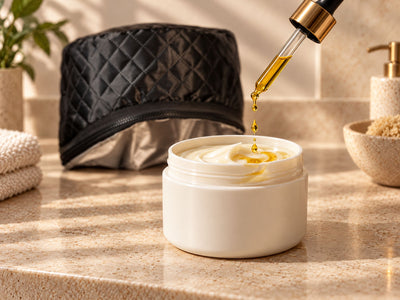
- Keep wash day consistent. Weekly cleansing and conditioning keeps moisture going in. I add low, gentle heat when conditioning, using my Heat Hat for 20 to 30 minutes. See How to Deep Condition Afro Hair at Home.
And be careful of anything promising faster growth from a bottle. Topical products typically don't influence growth unless they contain medicinal ingredients (curl specialist Anita Wilson). More in Should You Oil Your Scalp? and Rosemary Oil for Afro Hair Growth.

Measure more than length
If the only thing you measure is how far your Afro pulls from your face, you'll end up impatient and disappointed. Density, elasticity and hydration are wins too. Take progress photos (front, back and sides, in the same light) and keep a hair journal so you have proof on the days you can't see change.
Frequently asked questions
Why won't my Afro hair grow?
Unless a medical professional says otherwise, it is growing, about half an inch a month on average. The issue is usually retaining length through gentle, low-manipulation care.
Is it normal to lose hair on wash day?
Yes. We shed 50 to 100 strands a day, so a week's worth comes out on wash day. Hair loss in clumps should be checked by a dermatologist.
Can stress make my hair shed?
Chronic stress, illness, dieting and pregnancy can trigger extra shedding, often six to twelve weeks after the trigger.
The Heat Hat Method
Length retention starts with a consistent wash day. I use my Heat Hat every wash day, even with basic conditioners, to help keep my hair hydrated and soft from one week to the next.
From the book
How to Love Your Afro by Paige Lewin
This post draws on Chapter Sixteen, Length Retention, and Chapter Four, Setting Realistic Goals. The Bloomsbury-published, Amazon bestselling guide to loving and caring for your natural hair — in hardback, Kindle and audiobook.
Amazon UK Amazon US Barnes & Noble Waterstones Blackwell's Roving Heights (Nigeria)
Paige xx

The Hair Journal, in your inbox
Get Paige's wash day tips first.
New Hair Journal posts, honest Afro hair education from How to Love Your Afro, and first access to new Team Texture drops.
Unsubscribe any time.


